
In the rush to the cloud, most enterprises have settled into a “hybrid” reality. We rely on encrypted tunnels — specifically Site-to-Site VPNs and dedicated private connections like Azure ExpressRoute or AWS Direct Connect — to act as the nervous system connecting on-premises data centers to cloud VPCs.
Because these gateways are encrypted and managed as infrastructure, they often become a security “no-man’s-land.” Security teams frequently assume that because the tunnel is “secure,” the traffic inside it is inherently safe. This is a dangerous blind spot. Attackers know that once they gain a foothold, these hybrid gateways are the perfect, high-bandwidth highway for lateral movement and silent data exfiltration.
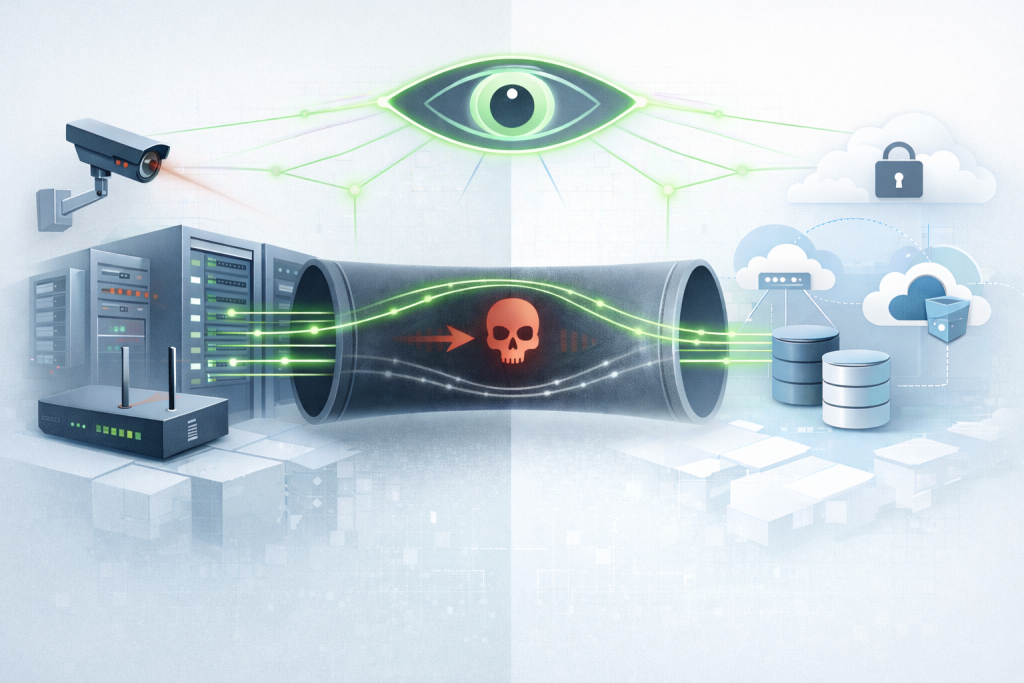
Why Hybrid Gateways are a “No-Man’s-Land”
The transition point between on-prem and cloud is uniquely difficult to monitor for three reasons:
- Encapsulation Overload: VPN and ExpressRoute traffic is encapsulated. Standard perimeter tools often see the “tunnel” but cannot easily peer inside to see the individual flows, protocols, or identities of the entities communicating across it.
- Ownership Gaps: Cloud teams often manage the VNet gateways, while networking teams manage the on-prem routers. Without a unified telemetry source, identifying a breach that spans both environments requires manual, cross-team coordination that takes hours.
- The “Trust” Fallacy: Many organizations don’t apply the same level of inspection to internal “east-west” hybrid traffic as they do to “north-south” internet traffic. Attackers exploit this by using these trusted pipes to move stolen data toward cloud storage buckets where it can be easily exfiltrated to the public internet.
Eliminating the Blind Spot with NFO
NetFlow Optimizer (NFO) eliminates this no-man’s-land by providing deep, flow-level visibility at both ends of the hybrid gateway.
1. Correlating the Hand-Off
NFO ingests binary flow data (NetFlow/IPFIX) from your on-premises edge routers and simultaneously ingests cloud telemetry like Azure VNet Flow Logs or AWS VPC Flow Logs. By normalizing these disparate formats into a single, standardized JSON stream, NFO allows you to trace a single conversation as it leaves your data center and enters your cloud environment — with zero gaps in visibility.
2. Detecting Lateral Movement in the Tunnel
Because NFO enriches flow records with Identity (Active Directory/Entra ID) and Threat Intelligence, it can spot anomalies that traditional monitors miss. If a legacy on-premises database server suddenly starts pushing gigabytes of data to a new, unauthorized S3 bucket in the cloud via the VPN, NFO flags it immediately as potential exfiltration, even if the tunnel itself is “healthy.”
3. Monitoring Gateway Performance vs. Security
NFO doesn’t just watch for threats; it monitors the gateway’s health. By correlating SNMP metrics (CPU/Memory/Interface drops) from the physical VPN concentrator with the actual flow volume, you can distinguish between a hardware bottleneck and a Distributed Denial of Service (DDoS) attack targeting your hybrid link.
The Bottom Line: Zero Trust for the Hybrid Pipe
A “secure” tunnel is only secure if you know what is moving through it. By applying the principles of Zero Trust Security to your hybrid gateways, you ensure that your VPN and ExpressRoute connections aren’t being turned against you.
With NFO, the transition point between on-prem and cloud is no longer a no-man’s-land—it’s the most visible part of your network.
Don’t let your hybrid gateway be your biggest security blind spot. Start monitoring your encrypted tunnels with the same rigor as your public perimeter.
Secure Your Hybrid Gateway Today Download a free trial of NetFlow Optimizer or explore our technical documentation on Cloud Flow Log Integration.