For decades, network operations teams have been trapped in a reactive cycle. We wait for an alert—a core switch hits 95% CPU utilization, an interface drops packets due to saturation, or a critical link fails under load—and then we scramble to fix it.
This break-fix model is no longer sustainable. As networks become more complex and distributed, the cost of downtime skyrockets, and the window for acceptable performance narrows. The solution is a fundamental shift from reactive troubleshooting to proactive, predictive maintenance.
The key to unlocking this shift lies in your network telemetry. By harvesting and analyzing granular infrastructure metrics, you can transform raw data into a crystal ball, forecasting hardware exhaustion weeks or even months before it impacts your business.
The Limitations of Reactive Monitoring
Standard monitoring tools excel at telling you what is happening right now. They are highly effective at alerting you when a predefined threshold is crossed. However, this “snapshot in time” approach has a significant blind spot: it cannot account for growth trends or subtle performance degradation over time.
By the time a reactive alert triggers, the damage is often already done. User experience has suffered, data packets have been dropped, and your team is in crisis mode. Relying solely on real-time alerts means you are always reacting to the past, rather than planning for the future.
Harvesting the Right Telemetry with NFO
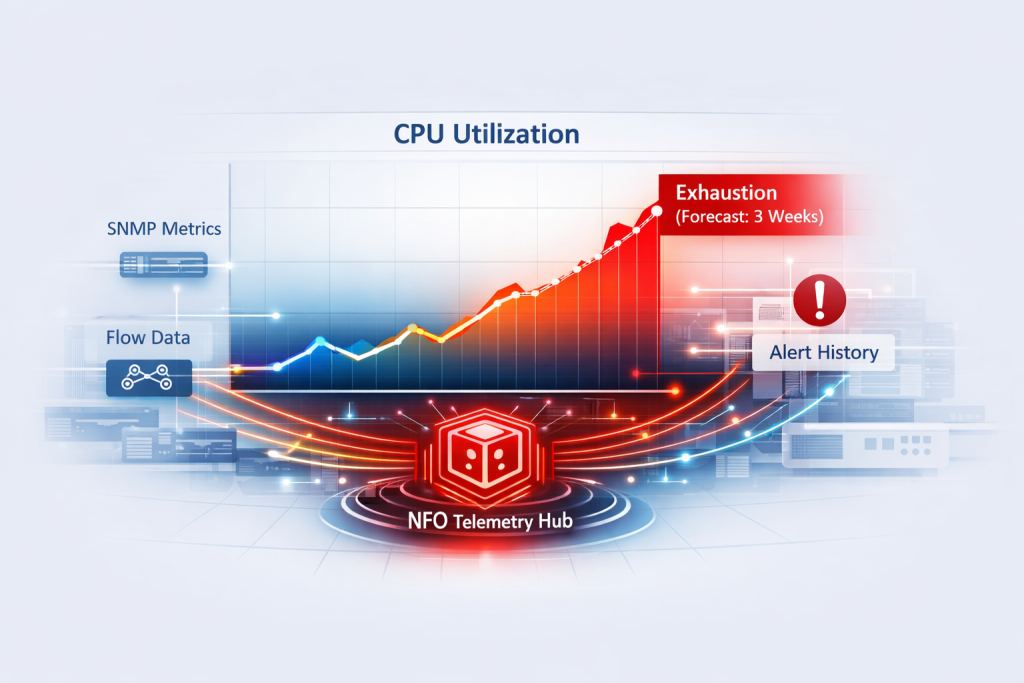
To build a predictive model, you need high-fidelity, high-granularity data. This is where NetFlow Optimizer (NFO) is essential. NFO doesn’t just collect flow data; it acts as a centralized telemetry hub, normalizing and enriching diverse data streams, including:
- Granular SNMP Metrics: Polling frequency matters. NFO can collect highly frequent, multi-vendor SNMP data (including CPU and memory utilization) that traditional bulk pollers often miss, providing the fine-grained resolution needed for accurate trend analysis.
- Enriched Flow Data: NFO enriches NetFlow/IPFIX with context (such as identity or Geo-IP), allowing you to correlate infrastructure metrics with the actual applications and users consuming those resources. This level of detail is a prerequisite for sophisticated observability, a topic explored in our blog on moving from monitoring to observability.
By centralizing and processing this data in real-time, NFO ensures that your downstream analytics platform receives a clean, consistent, and highly detailed data set.
Turning Data into Forecasts
Once this enriched telemetry is flowing into an analytics platform like Splunk or Microsoft Sentinel, you can leverage their native machine learning (ML) capabilities to create predictive models.
Forecasting Hardware Saturation
Instead of alerting on current utilization, you can build a model that analyzes historical usage patterns to project future load. This allows you to generate alerts such as: “Based on the last 90 days of traffic growth, Core Switch A will hit 90% CPU utilization in 24 days.” This advance warning gives you ample time to plan hardware upgrades, rebalance traffic loads, or optimize application configurations—all during scheduled maintenance windows.
This proactive approach is especially critical for hybrid environments, where understanding both on-premises and cloud VPC flow logs is necessary for true end-to-end capacity planning.
Spotting Anomalous Performance Degradation
Predictive analytics can also identify subtle hardware issues that might not trigger a standard threshold alert. For example, a slow, linear increase in memory usage over several weeks might indicate a memory leak in a device’s operating system. A predictive model can flag this slow drift as anomalous, enabling you to patch the device or engage the vendor for support before a catastrophic failure occurs.
The Bottom Line
Predictive capacity planning isn’t just about avoiding downtime; it’s about operating with efficiency and confidence. By utilizing the full spectrum of your network telemetry—normalized, enriched, and processed by NFO—you move from reactive chaos to proactive control.
Don’t wait for your hardware to tell you it’s exhausted. Use your data to forecast the future and build a more resilient network.
Ready to transform your network telemetry into actionable foresight? Stop reacting and start predicting.
Download a Free Trial of NFO or Schedule a Personalized Demo with our team to see how we can help you build a predictive capacity planning strategy.