
In the world of network operations, “High Availability” has traditionally been a reactive game. We set thresholds, wait for an alert to trigger when a CPU hits 90% or a fan fails, and then scramble to fix it. But in a 24/7 digital economy, waiting for a threshold to be breached is already too late-the performance degradation has already begun.
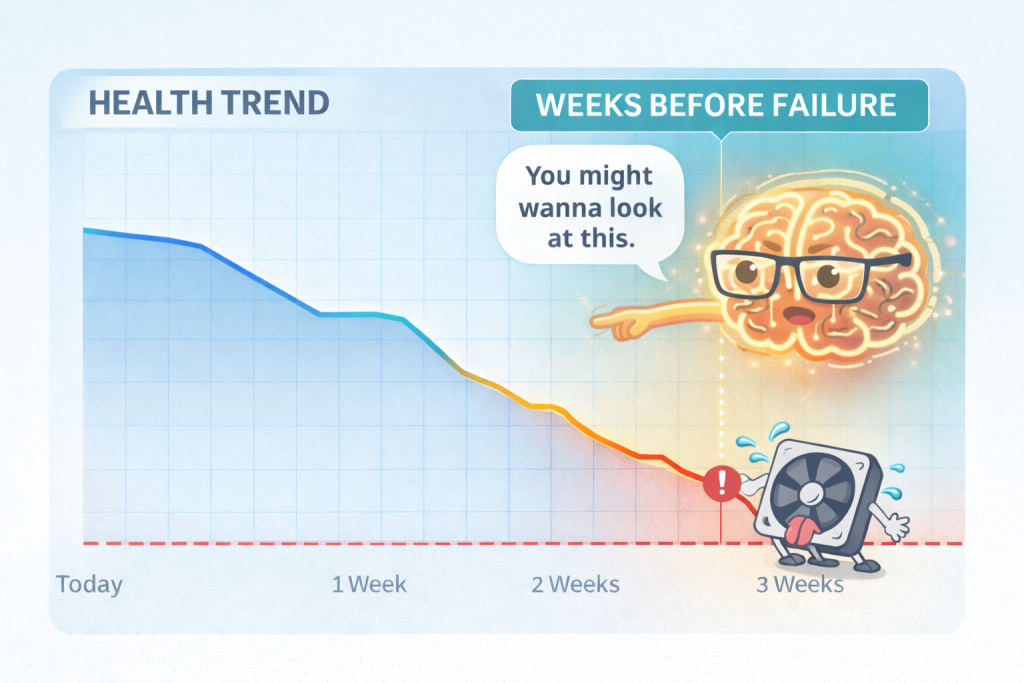
The next frontier of network resilience is Predictive Maintenance. By moving from reactive alerts to AI-driven forecasting, organizations can identify component degradation weeks before it results in an outage.
The fuel for this transformation? High-fidelity, historical SNMP telemetry. The NetFlow Optimizer (NFO) provides the granular, vendor-specific health data necessary to train the AI/ML models that turn network failure into a forecast.
The Challenge: AI is Only as Good as Its Training Data
Artificial Intelligence and Machine Learning (AI/ML) models have the potential to revolutionize network management, but they face a major hurdle: The Data Gap.
Most standard monitoring tools only retain “summary” data or delete granular polling records after a few days to save space. To accurately predict a failure, an AI model needs a long-term, high-resolution history of how a component behaves under various loads. Without this historical context, the AI cannot distinguish between a normal “busy hour” and the early “shaking” of a hardware component beginning to fail.
NFO: Providing the Raw Material for Predictive Insights
NFO’s SNMP polling engine doesn’t just report current status; it enables the collection and streaming of deep, vendor-specific metrics (custom OID sets) that serve as the perfect training set for predictive models.
1. Tracking Component “Wear and Tear”
NFO allows engineers to poll and store metrics that are often overlooked, such as internal chassis temperature, power supply voltage fluctuations, and fan RPMs.
- The Predictive Signal: A fan doesn’t usually stop instantly. It begins to vibrate or slow down over weeks. By feeding NFO’s historical SNMP data into an ML model, the system can detect a subtle downward trend in RPMs that a human observer-or a static alert-would never notice.
2. Identifying Capacity Bottlenecks Before the Crash
Predicting failure isn’t just about hardware breaking; it’s about resources being exhausted. NFO tracks historical CPU load, memory usage, and interface error rates across all vendor hardware.
- The Predictive Signal: An ML model can correlate a gradual, day-to-day (or hour-to-hour) increase in memory utilization with specific traffic patterns. NFO provides the historical baseline needed for the model to forecast the exact date a core switch will hit a “memory leak” or capacity ceiling, allowing for a proactive upgrade or configuration change.
3. High-Fidelity Data for Anomaly Detection
AI models require a “clean” baseline of what “normal” looks like. Because NFO focuses on reporting relevant, high-value metrics rather than a flood of useless OIDs, the data exported to your IT Operations system or AI/ML platform is already optimized. This high signal-to-noise ratio speeds up model training and improves the accuracy of anomaly detection.
The Workflow: From Polling to Prediction
- Ingestion: NFO polls vendor-specific OIDs for critical hardware components (Power, Thermal, Processing).
- Optimization: NFO filters and formats this telemetry, sending a high-fidelity stream to your analytics platform (e.g., Splunk, Azure Monitor, or a dedicated AI engine).
- Forecasting: The AI/ML model analyzes the historical trends provided by NFO to identify “Pre-Failure” signatures.
- Action: The system generates a “Predictive Maintenance” ticket. A technician replaces a $50 fan on a Tuesday afternoon, preventing a $50,000 outage on a Friday night.
Conclusion: Data-Driven Resilience
The shift from “Failure” to “Forecast” is the ultimate goal of the modern IT organization. It reduces emergency labor costs, extends the lifespan of expensive hardware, and-most importantly—guarantees a seamless user experience.
By leveraging NetFlow Optimizer to capture and stream the deep metrics hidden within your network components, you aren’t just monitoring your network—you are teaching it to tell you when it needs help.
Are you ready to stop reacting and start forecasting?
Contact us today to learn how NFO can provide the data f