
The threat landscape is shifting under our feet. According to the Radware 2025 Global Threat Analysis Report, 2024 was a year of “unprecedented escalation,” marked by a staggering 550% year-over-year increase in Web DDoS attacks. Attackers are no longer just throwing massive amounts of data at your network; they are becoming more sophisticated, more patient, and more targeted.
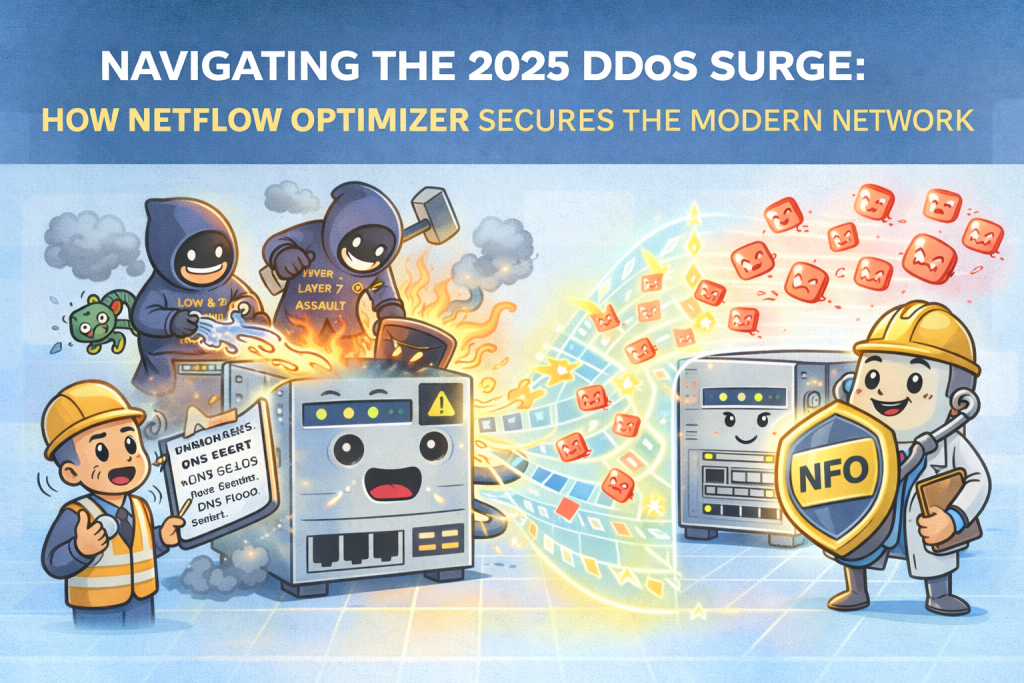
For organizations relying on traditional monitoring, these shifts create dangerous blind spots. This is where NetFlow Optimizer (NFO) becomes a critical pillar of your defense strategy.
The New Reality of DDoS Attacks
The Radware report highlights three critical trends that are redefining the DDoS threat:
- The Rise of “Low and Slow”: Attackers are increasingly using “low and slow” strategies—stealthy streams of traffic designed to deplete resources while remaining under the radar of traditional volumetric detection22. In 2024, these attacks increased by 38%, with their average duration doubling to 9.7 hours.
- Sophisticated Layer 7 (L7) Assaults: Beyond simple network-layer floods, attackers are exploiting application-layer vulnerabilities, such as HTTP/2 Rapid Reset and Continuation Flood, to overwhelm backend infrastructure.
- DNS Flood Dominance: 2024 saw an 87% surge in DNS query flood attacks. DNS amplification remains the king of volumetric methods, accounting for 65% of all amplification-based attacks.
Why NetFlow Optimizer is Crucial for Detection
To counter these evolving threats, you need more than just perimeter defense; you need high-fidelity visibility into the heart of your network. NFO plays a dual role in identifying both the massive spikes and the subtle tremors of a DDoS campaign.
1. Catching the “Low and Slow” Before They Strike
Because NFO can ingest and process massive volumes of flow data in real-time, it excels at identifying the “minimal data volumes and deliberate intervals” that characterize low and slow attacks. By enriching flow data with identity context and reporting relevant metrics, NFO allows your SIEM to correlate tiny traffic anomalies that would otherwise be lost in the noise.
2. Visualizing Volumetric and DNS Floods
While network DDoS attacks have become more prolonged and resource-intensive, NFO provides the real-time telemetry needed to see them coming. By monitoring DNS amplification and UDP-based flood patterns, NFO ensures that your security teams aren’t just reacting to a downed server, but are instead watching the “unprecedented” 120% rise in total attack volume as it happens.
3. High-Fidelity Data for Modern SIEMs
The democratization of DDoS through DDoS-for-hire services means that large-scale attacks are now available to anyone with a Telegram account. To defend against this “democratized” threat, your SIEM—whether it’s Splunk, Azure Monitor, or Datadog—requires high-signal data. NFO filters out the “chaos of OIDs” and raw flow noise, sending only the pre-processed, identity-enriched events that lead to instant detection.
Conclusion: From Reaction to Resilience
The Radware report is a wake-up call: cyberthreats are becoming “more adept at circumventing traditional defenses”. Whether it’s foreign government-sponsored hacktivist collectives coordinating on Telegram or “grey bots” scraping data for AI models, the modern network is under constant, sophisticated siege.
By integrating NetFlow Optimizer into your security stack, you gain the visibility required to identify both the “massive volumetric campaigns” and the “insidious” low-and-slow vectors that define today’s landscape.
Don’t wait for the next 16 million RPS attack to hit your gateway. Transform your network telemetry into actionable intelligence with NFO.
Are you ready to see what’s really happening in your network? Contact us today to learn how NFO can sharpen your DDoS detection and reduce your MTTR.