
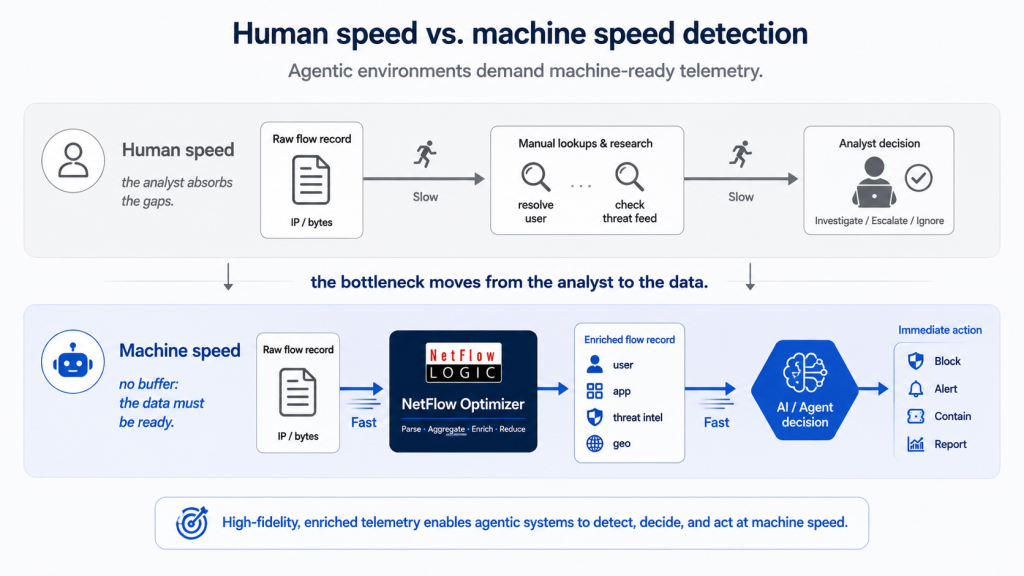
For two decades, detection and response ran at human speed: an alert fired, an analyst gathered context and acted, and the whole loop was paced by how fast a person could think. Agentic AI is collapsing that timeline. Attackers are beginning to move through environments faster than any human defender can follow, and defenders are responding with agentic detection and response of their own. At Cisco Live 2026, Splunk introduced Agent Builder, a no-code way to build agentic operations that run directly from Splunk searches and alerts, triaging and investigating at machine speed.
When the loop moves to machine speed, the source of advantage shifts. The bottleneck is no longer the analyst. It is the data. An autonomous system that acts in seconds is only as good as the telemetry it acts on. If that telemetry is incomplete, unenriched, or late, the system does not fail slowly the way a human would. It fails fast, and it acts on the failure.
Machine Speed Changes the Cost of Bad Data
At human speed, thin telemetry is an inconvenience. An analyst working from a record of IP addresses and byte counts can compensate: resolve the user, check the destination, infer the application. The human is a buffer whose judgment absorbs the gaps.
At machine speed, that buffer is gone. An autonomous system acts on what it is given, immediately. If the data lacks context, the system makes the wrong call as fast as it would have made the right one, then takes an automated action on it: blocking a legitimate user, isolating a healthy system, escalating a false alarm. Announcing Cisco’s intent to acquire WideField Security, Splunk SVP and GM Kamal Hathi described exactly this risk: the agentic era introduced a new class of security problem in which authorized entities take unsafe actions in the wrong context, which can cause significant damage before any human team has a chance to respond.
A human acting on incomplete data fails slowly and can catch the mistake. An autonomous system acting on incomplete data fails fast and acts on it. Machine-speed detection does not reduce the need for data quality. It raises the stakes on it.
What Machine-Speed Detection Needs from Network Data
- Pre-enriched, not enrichable. User identity, application, threat intelligence, and geographic origin have to be in the record when it arrives, not available through a lookup the agent could theoretically run. An agent acting in seconds cannot afford the round trip.
- Structured and consistent. Autonomous systems reason over data with predictable shape. Telemetry in inconsistent formats, or normalized on the fly, introduces the ambiguity that produces fast wrong decisions.
- Timely and sustainable at volume. Machine-speed detection is continuous, and agentic workloads generate far more traffic than the human-era baseline. The data must arrive without lag and stay affordable to collect and retain at that scale.
Raw NetFlow meets none of these. It is thin, it is binary and inconsistent across device types, and at agentic volumes it is expensive to move and store. That gap has to be closed before the data reaches the decision layer.
Cisco has named this requirement directly. In the same WideField announcement, Hathi wrote that for agentic security operations that enable autonomous responses, it is imperative to have deterministic data pipelines that correlate telemetry from endpoints, identity systems, networks, and cloud in a format optimized for AI consumption. Network telemetry is one of those sources, and raw NetFlow is not in a format optimized for anything.
Closing the Gap Before the Decision Layer
NetFlow Optimizer (NFO) sits between the network devices that export flow data and the systems that act on it, turning raw flow into telemetry that is ready the instant it arrives. It parses binary NetFlow, normalizes it to a common information model, enriches every record with identity, application, threat intelligence, and geographic context, and reduces volume by 80 to 90% through aggregation so continuous visibility stays sustainable as agentic traffic grows. The finished, CIM-compliant records are delivered to Splunk, Sentinel, Exabeam, Kafka, or another consumer.
| What machine-speed detection needs | What NFO delivers |
| Context present in the record | Identity, application, threat intel, geo enriched pre-delivery |
| Consistent, structured shape | Normalized to a common information model (CIM) |
| Timely, sustainable at volume | 80 to 90% volume reduction via aggregation, no lag |
NFO does not detect, alert, analyze, or decide. It makes the decision layer possible by ensuring the data arriving there is complete, structured, and ready. The detection logic and autonomous response live downstream, where the organization builds and owns them.
Why the Data Layer Decides
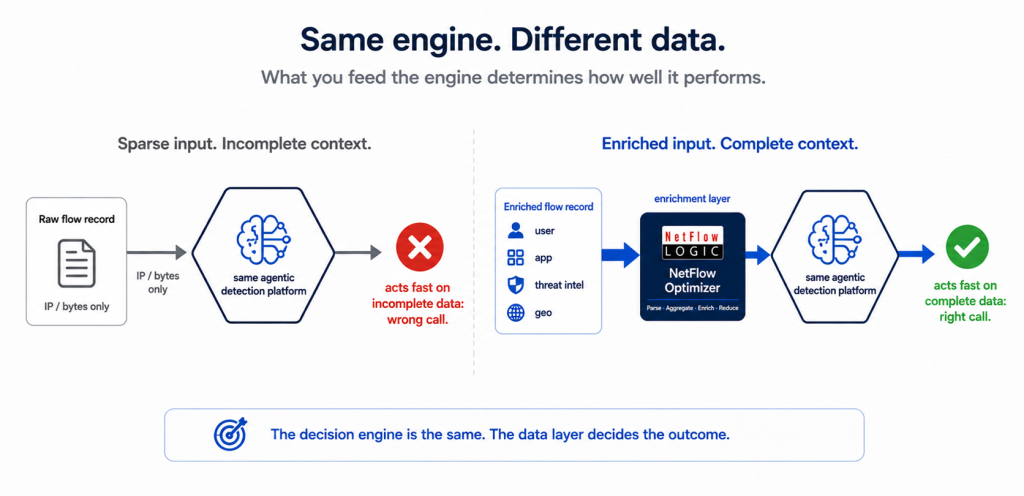
As detection moves to machine speed, the decision engines converge. Autonomous response platforms and agentic frameworks are increasingly built on shared platforms and common patterns: Splunk’s Agent Builder, for instance, is scheduled for general availability on Splunk Cloud Platform in Fall 2026, putting no-code agentic operations in reach of any team on the platform. When the engines are broadly available, what differs between organizations is the quality of the data those engines run on.
Two organizations can deploy the same agentic platform. The one feeding it enriched, structured, timely network telemetry catches what the other misses, and acts correctly where the other acts wrongly. The engine is the same. The data layer is what makes it win or lose, which is why it deserves attention now, before the transition completes and there is no human buffer left to absorb its weaknesses.
The Bottom Line
At human speed, an analyst’s judgment compensates for thin data. At machine speed, that buffer disappears and the data becomes the deciding factor. Autonomous systems act on what they are given, instantly, right or wrong. NFO makes sure what they are given is enriched, structured, timely, and sustainable at scale.
The decision engines will converge. The data layer is where the advantage lives.
Preparing your SOC for machine-speed detection and response? Start a free 60-day trial of NetFlow Optimizer or schedule a technical demo.
Start Free Trial | Schedule a Demo | Splunk Integration | NFO Documentation