
SD-WAN is now standard enterprise infrastructure. By 2024, 87 to 90 percent of enterprises had either deployed or were actively deploying SD-WAN, and the question has shifted from whether to deploy it to whether it is working as designed. That second question is harder to answer than most organizations expect.
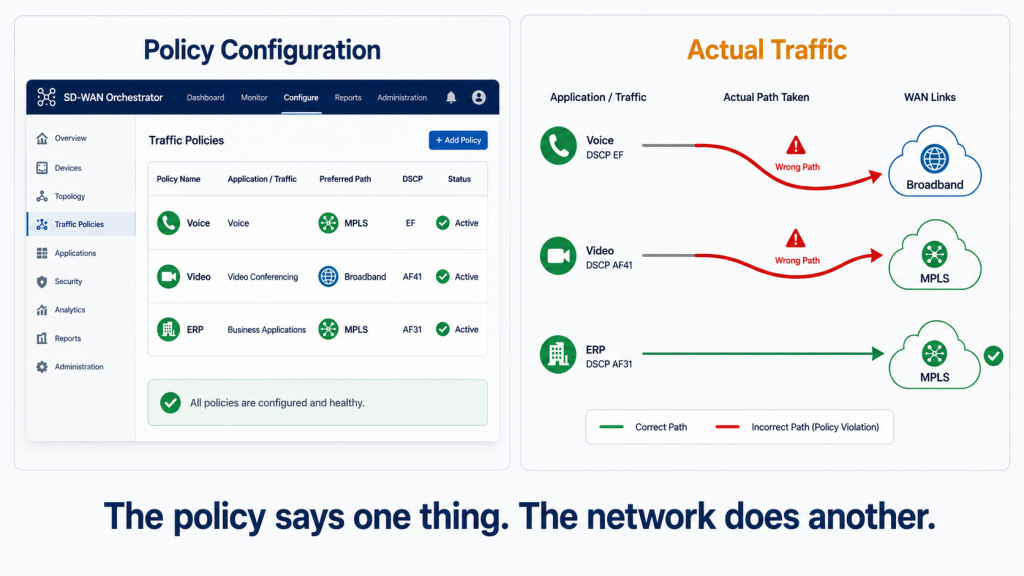
SD-WAN promises intelligent traffic steering: Gold-tier applications take the optimized path, critical voice and video flows receive consistent QoS treatment, and bandwidth is distributed efficiently across WAN links. The policies are configured. The orchestrator shows green. But whether traffic is actually flowing the way the policy intends, at the application level and across every branch, is rarely verified with hard evidence.
The SD-WAN orchestrator tells you what the policy is configured to do. NetFlow telemetry tells you what the network is actually doing. Those two things are not always the same.
This blog explains how NetFlow Optimizer (NFO) provides the per-flow visibility needed to validate SD-WAN policy enforcement across three dimensions: application traffic path verification, QoS marking accuracy, and bandwidth utilization.
The SD-WAN Validation Gap
SD-WAN orchestration platforms provide centralized policy management and dashboards showing link health, latency, and aggregate throughput. What they do not provide is per-flow visibility into how individual application flows are being treated. Three validation questions arise consistently that the orchestrator alone cannot reliably answer:
- Is application traffic taking the right WAN path? Application classification at the SD-WAN edge depends on DPI accuracy. When an application is misclassified or a policy rule has an incorrect match condition, Gold-tier traffic can silently migrate to a suboptimal path without any alert firing.
- Are QoS markings being applied and honored end to end? Traffic may be correctly marked at the SD-WAN edge and stripped by a carrier handoff. The result is degraded voice and video quality that is difficult to attribute to its root cause without per-flow DSCP visibility.
- Is bandwidth distributed across WAN links as intended? Aggregate link utilization metrics cannot reveal which specific applications are using which links, whether expensive MPLS circuits are carrying traffic they should not be, or whether a branch is consistently overloading one link while another sits underutilized.
In each case, the orchestrator shows a healthy status. The gap between intended and actual behavior persists silently, degrading performance and wasting WAN capacity.
How NFO Provides SD-WAN Validation Visibility
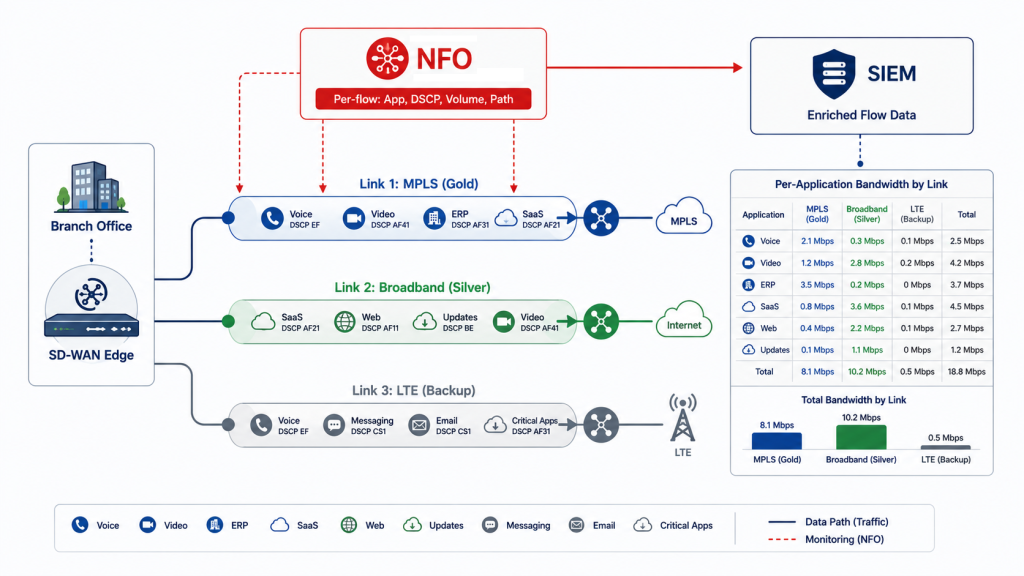
NFO ingests NetFlow and IPFIX from your SD-WAN edge devices and upstream routers. SD-WAN platforms from Cisco (Viptela and Meraki), VMware VeloCloud, Fortinet, and Aruba EdgeConnect all support NetFlow or IPFIX export. NFO normalizes this data across vendor formats, enriches it with application name, DSCP values, and user identity, and delivers it to your SIEM or monitoring platform. Full enrichment details are in the NFO documentation.
Application Traffic Path Verification
NFO enriches every flow record with application name through a prioritized resolution process: starting with user-defined custom application mappings, then device-reported application names carried directly in the flow record, then application ID mappings, and finally an auto-built Application Collector catalog derived from NetFlow records. This means application context is available regardless of whether the SD-WAN device exports DPI-classified names natively. The enriched data shows, for each application, which WAN interface it egressed from and at what volume. A query in your monitoring or analytics platform then answers the validation question directly: of all flows classified as a specific business-critical application, what percentage egressed from the intended link versus a secondary or backup path? If the answer deviates significantly from 100 percent on the intended path, the policy has a gap.
QoS and DSCP Marking Validation
NFO captures DSCP and ToS values in flow records at each collection point. Combined with application name enrichment, this makes it possible to verify whether a specific application flow carried the correct DSCP value at the branch edge versus at the data center ingress router. If the values differ, traffic is being remarked somewhere in the path, and the location of the remark is identifiable by comparing DSCP values across NFO collection points.
Bandwidth and Link Utilization Analysis
NFO delivers per-flow, per-interface bandwidth data at the application level. This answers the capacity questions that aggregate link monitoring cannot: which applications are consuming bandwidth on each WAN link, whether expensive MPLS circuits are carrying traffic that policy should route to broadband, and whether a branch is generating unexpected application mixes on specific interfaces. For capacity planning, this visibility replaces guesswork with evidence before a hardware investment is made.
What Validation Looks Like in Practice
| Validation Question | What the Orchestrator Shows | What NFO Per-Flow Telemetry Adds |
| Is application X taking the right WAN path? | Policy configured to steer application X to Link A. Link A shows as active. | Of 14,847 flows classified as application X this week, 82% egressed Link A, 18% egressed Link B. Policy enforcement gap identified. |
| Are voice flows marked DSCP EF (46) end to end? | QoS policy configured to mark voice DSCP EF at the SD-WAN edge. Application health metrics may show voice quality degradation as a symptom. | Branch edge: DSCP 46 confirmed. Data center ingress: DSCP 0 on 34% of voice flows. Remarking detected at carrier handoff. Root cause identified. |
| Is the MPLS circuit carrying only intended traffic? | MPLS circuit utilization: 73%. No alerts. | MPLS circuit carrying 340GB of streaming video this week. Policy intent: streaming video to broadband only. Misclassification detected. |
Each scenario represents a case where the orchestrator shows a healthy status while per-flow telemetry reveals a real divergence from policy intent. Without this visibility, these gaps persist and accumulate.
The Security Dimension of SD-WAN Validation
Policy validation is not purely an IT operations concern. Misconfigured SD-WAN traffic has direct security implications:
- Traffic intended to traverse security inspection (next-generation firewall, cloud security broker) may bypass that inspection if steered to an alternative path due to policy misconfiguration. The orchestrator shows the policy as correct; the traffic avoids inspection.
- Applications that should firewall at the data center may take a direct internet breakout at the branch if SD-WAN classification places them in the wrong policy tier. Per-flow visibility confirms that security-sensitive traffic is taking the intended path through the intended inspection points.
- Unauthorized applications consuming WAN bandwidth are immediately visible in application-attributed flow records. Shadow IT at branch locations is difficult to detect from aggregate link metrics.
For organizations where SD-WAN spans government facilities or DoD contractor sites, traffic path verification supports network monitoring obligations under OMB M-21-31 and CMMC 2.0. For more on how NFO supports federal compliance, see OMB M-21-31 and Network Flow Logging.
The Bottom Line
SD-WAN policy configuration is the beginning, not the end. The orchestrator manages what the policy is intended to do. Per-flow NetFlow telemetry shows what the network is actually doing, at the application level, across every WAN link, every day.
The policy is configured. The question is whether it is enforced.
Want to validate your SD-WAN policy enforcement with per-flow visibility? Start a free 60-day trial of NetFlow Optimizer or schedule a technical demo.
Start Free Trial | Schedule a Demo | NFO Documentation | Splunk Integration