
SIEM migrations are among the highest-risk projects a security operations team will run. Whether the driver is a platform consolidation, a licensing decision, a move to a new analytics architecture, or the ripple effects of vendor mergers reshaping the market, the pattern is the same. For a period of weeks or months, the organization runs two SIEMs at once, shifts data sources one at a time, rebuilds detection content, and revalidates dashboards. During that window, visibility is fragile.
The risk is not theoretical. Migrations are exactly when telemetry pipelines break. Data sources that were carefully tuned for the old platform must be re-pointed at the new one. Formats that the old SIEM parsed cleanly may not map to the new schema. Sources get moved, and for a time they report to neither system, or to both inconsistently. The NOC and SOC are asked to maintain the same operational and security coverage while the ground shifts underneath them.
Network flow telemetry is one of the sources most exposed to this risk, and one of the most painful to lose. This blog looks at why, and at how a dedicated telemetry pipeline keeps network visibility intact through a SIEM migration instead of treating it as a casualty of the cutover.
Why Network Telemetry Is Fragile During Migration
Most log sources have a relatively simple relationship with the SIEM: an agent or forwarder ships text-based events, and the SIEM parses them. Re-pointing that source at a new SIEM is often a configuration change.
Network flow telemetry is different, and harder, for a few reasons.
- Raw flow data is binary. NetFlow, IPFIX, sFlow, and J-Flow are exported by network devices in binary formats that a SIEM cannot ingest directly. Something has to parse and normalize that binary into structured records the SIEM understands. If that translation layer is tied to the old SIEM’s tooling, it does not simply move.
- Formats and schemas are SIEM-specific. Flow data normalized for one platform’s data model is not automatically compatible with another’s. Field mappings, naming conventions, and compliance with a common information model differ between platforms. What parsed cleanly before may need rework.
- Device reconfiguration carries operational risk. If the only way to move flow telemetry is to reconfigure export settings on production routers, switches, and firewalls, that means touching production network infrastructure during an already-risky migration. Each device change is a chance to misconfigure, drop exports, or double-send.
- Enrichment is easy to lose. Identity resolution, application naming, threat intelligence context, and geographic data that made flow records useful in the old SIEM may have been built into that SIEM’s pipeline. Move the raw flow to a new platform and the enrichment does not come with it.
The result is that network visibility, one of the harder capabilities to establish in the first place, is disproportionately likely to degrade or disappear during a migration, precisely when the security team can least afford a blind spot.
The Decoupling Principle
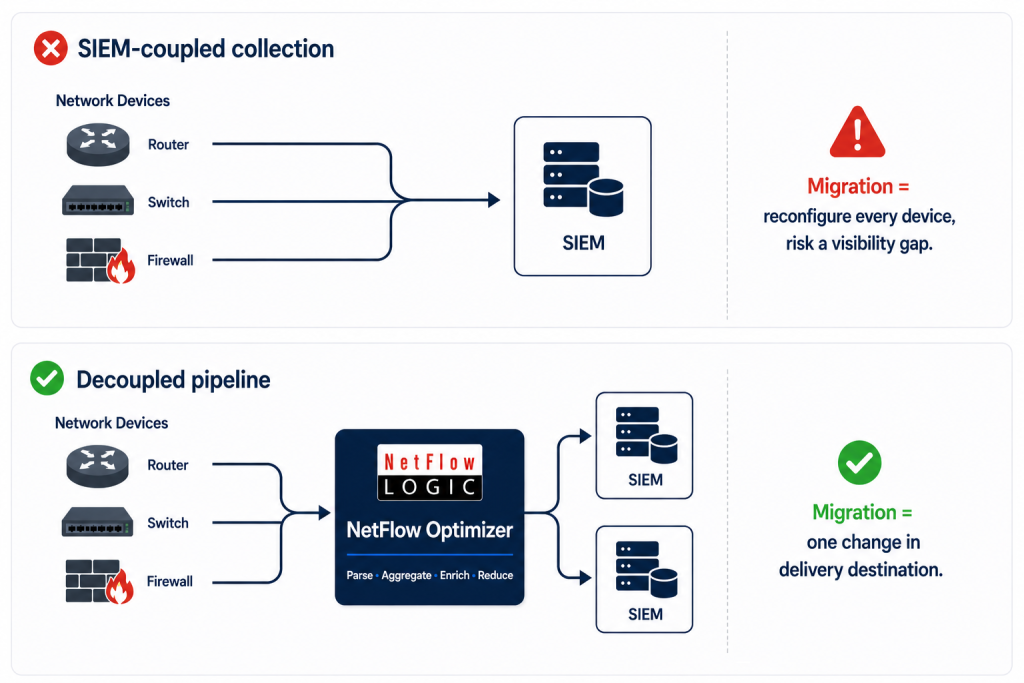
The way to keep network visibility resilient through a migration is to stop treating the SIEM as the thing that collects and processes flow telemetry. The collection, parsing, normalization, and enrichment of network flow data should live in a dedicated pipeline that sits between the network devices and the SIEM, independent of which SIEM is downstream.
When that pipeline is decoupled from the SIEM, the migration problem changes shape. The network devices keep exporting flow data to one stable destination: the pipeline. The pipeline keeps parsing binary, normalizing, and enriching exactly as before. The only thing that changes during migration is where the pipeline delivers its finished output, and that is a configuration change in one place, not a reconfiguration of the entire network fabric.Decoupling network telemetry collection from the SIEM turns a migration from a fabric-wide reconfiguration into a single change in delivery destination. The network devices never have to know the SIEM changed
How NFO Keeps Visibility Intact
NetFlow Optimizer (NFO) is a dedicated network telemetry pipeline that sits between your network infrastructure and your SIEM. That position is exactly what makes it a migration asset rather than a migration casualty.
Network devices export to NFO, not to the SIEM.
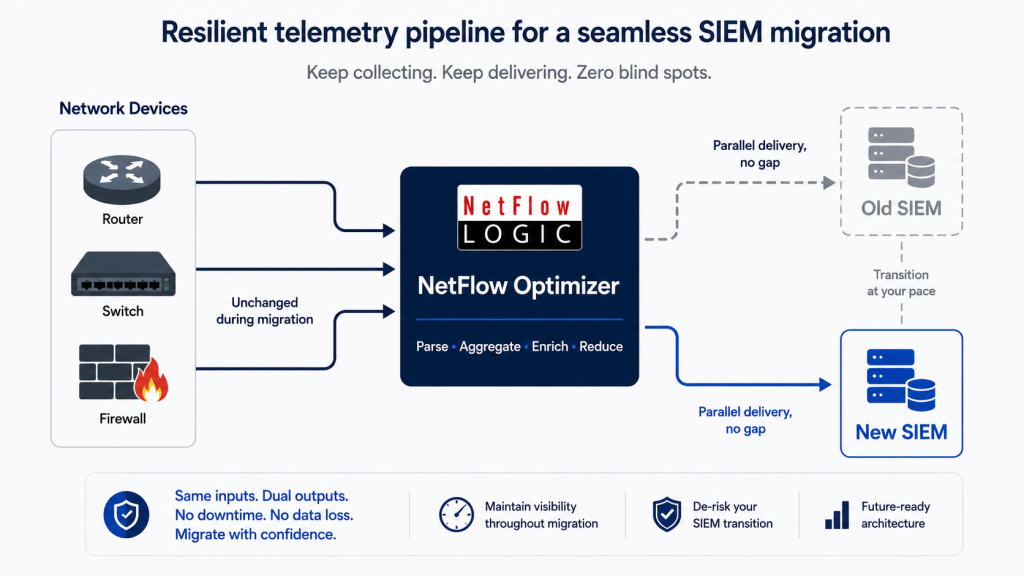
Routers, switches, and firewalls send their raw NetFlow, IPFIX, sFlow, and J-Flow to NFO. They do not need to know or care what SIEM sits downstream. During a migration, their configuration does not change at all. This removes production network reconfiguration from the migration critical path entirely.
NFO handles parsing, normalization, and enrichment independent of the SIEM.
NFO parses the binary flow data, normalizes it to a common information model, and enriches every record with user identity, application name, threat intelligence context, and geographic data. This processing is a property of the pipeline, not of the SIEM. Whatever platform sits downstream receives the same enriched, structured, CIM-compliant telemetry.
NFO can deliver to old and new SIEM at the same time.
Because delivery is a configuration of the pipeline, NFO can send its enriched output to more than one destination during the transition. The security team can run the old SIEM and the new one in parallel, validating that detection content, dashboards, and correlation rules work on the new platform before decommissioning the old one. Network visibility is continuous on both systems throughout the cutover, with no gap and no period of running blind.
The Broader Case for a Dedicated Pipeline
A SIEM migration makes the value of a decoupled telemetry pipeline obvious, because the pain of not having one is concentrated into a single high-stakes project. But the same architecture pays off well beyond the migration itself.
Once network telemetry collection and enrichment are independent of the SIEM, the organization is no longer locked into a single downstream platform. Flow telemetry can be delivered to a SIEM, a data lake, a Kafka stream, or object storage in parallel, each consumer receiving the same enriched records. Future platform decisions, whether adding a security data lake, adopting a new analytics tool, or consolidating platforms after a merger, become delivery changes rather than collection rebuilds.
The migration is the moment the investment proves itself. The architecture is what keeps proving itself afterward.The Bottom Line
The Bottom Line
A SIEM migration should not cost you network visibility. When the collection, parsing, normalization, and enrichment of flow telemetry live in a dedicated pipeline instead of inside the SIEM, migration stops being a fabric-wide reconfiguration and becomes a single change in delivery destination. NFO keeps enriched network telemetry flowing to the old SIEM and the new one at the same time, so the NOC and SOC never run blind through the cutover.
Migrations are hard enough. Network visibility does not have to be one of the things that breaks.
Planning a SIEM migration or consolidation? Start a free 60-day trial of NetFlow Optimizer or schedule a technical demo to see how a decoupled telemetry pipeline keeps network visibility intact through the cutover.
Start Free Trial | Schedule a Demo | Splunk Integration | NFO Documentation