
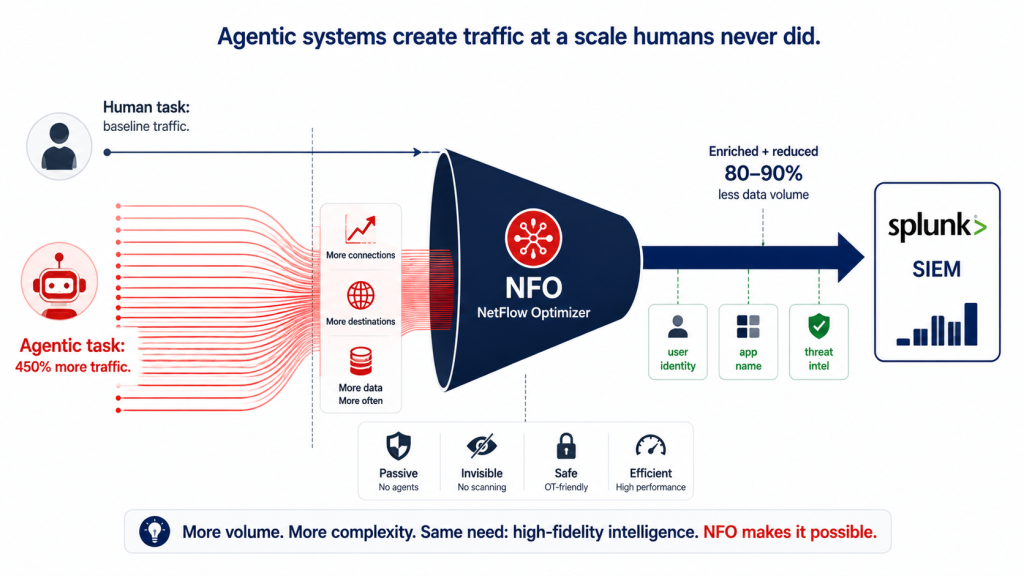
Cisco recently put a number on something network teams have started to feel: a single agentic AI task generates 450% more network traffic than a human doing equivalent work. That figure, published in Cisco’s July 2026 analysis of embedded network security, is worth sitting with. It means that as organizations move from AI assistants that answer questions to AI agents that take actions, the traffic those systems generate does not grow incrementally. It multiplies.
An agent does not send one request and wait. It queries multiple systems, chains API calls, retrieves context from several sources, validates results, and repeats. Each step is a network conversation. Where a human analyst might touch three systems to resolve a task, an agent orchestrating the same workflow touches dozens, and it does so continuously, in parallel, across the environment.
For network and security teams, this creates a problem that arrives from two directions at once. The volume of network telemetry is about to increase sharply, at the same moment that the value of seeing and understanding that telemetry has never been higher. Both pressures land on the same infrastructure, and both point to the same conclusion: raw flow data, unprocessed, is no longer a viable way to feed a SIEM.
Two Problems, One Root Cause
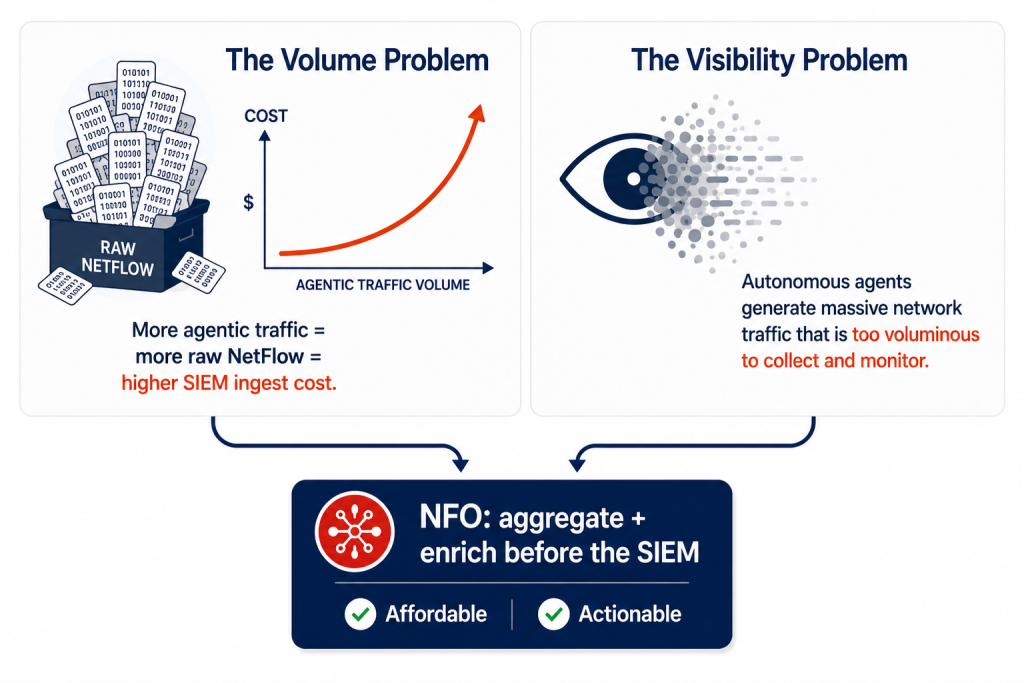
The agentic traffic explosion is not one challenge. It is two, and they compound each other.
The volume problem.
More traffic means more flow records. A network that generated a manageable volume of NetFlow last year can generate multiples of that as agentic workloads scale. Every one of those flows, if sent raw to a SIEM, consumes ingest capacity, storage, and license cost. For Splunk customers, where ingest volume is directly tied to cost, an unfiltered flood of agentic-era NetFlow is financially untenable. The instinct to simply not collect NetFlow, to avoid the volume, is exactly the wrong response, because it creates the second problem.
The visibility problem.
Agentic systems make autonomous decisions and take autonomous actions. As covered in The Agentic SOC’s Network Blind Spot, those decisions are only as good as the data behind them. The traffic an agent generates, and the traffic it should be monitored against, is network traffic. If that traffic is invisible because the volume made it impractical to collect, the organization is running autonomous systems across a network it cannot see.
These two problems have the same root cause, and therefore the same solution. The flow telemetry must be reduced in volume before it reaches the SIEM, and it has to be enriched with context before it gets there, so that what does arrive is both affordable and useful.
Why Raw NetFlow Fails at Agentic Scale
A raw flow record is a thin object. Source IP, destination IP, ports, protocol, byte and packet counts, timestamps. At human scale, a security team can afford to collect these and resolve the missing context later: look up which user was behind an IP, check whether a destination is malicious, identify which application a port belongs to. That manual enrichment is slow but survivable when the volume is modest.
At agentic scale, both halves of that model break. The volume makes raw collection expensive, and the manual enrichment cannot keep pace with the traffic. An analyst cannot hand-resolve context for millions of additional flows per day, and an AI agent working from raw flow records is missing the identity, application, and threat context it needs to make a confident decision.
There is also a category of agentic traffic that raw NetFlow handles especially poorly: high-volume, repetitive, machine-to-machine conversations. Agents generate enormous numbers of similar flows, the same service talking to the same endpoints over and over. Sent raw, these produce a torrent of near-identical records that inflate cost without adding proportional insight.
What NFO Does with Agentic-Era Traffic
NetFlow Optimizer (NFO) sits between the network devices exporting flow data and the SIEM consuming it. It addresses both the volume and the visibility problem in the same pipeline, before the data lands downstream.
Volume reduction, primarily through aggregation.
NFO reduces flow volume by 80 to 90% before delivery. The primary mechanism is aggregation: combining many related flow records into meaningful summarized records that preserve the security and operational signal while collapsing the redundant repetition that agentic traffic produces in bulk. This is the reason most organizations have no NetFlow in their SIEM today: raw volume has always made it too expensive to justify, and the agentic traffic explosion only widens that gap. Aggregation inverts the economics. It makes full-fidelity NetFlow financially sustainable to add for the first time, precisely when agentic workloads make that telemetry most necessary. The point was never to see less. It is to make it possible to see everything without the cost scaling linearly with the traffic.
Enrichment, before the data reaches the SIEM.
Every flow record NFO delivers is enriched with context that a raw record lacks:
| Enrichment | What it adds to each flow |
| User identity | Resolved from AD, Entra ID, Okta, or VPN auth logs |
| Application name | From device DPI or the NFO application catalog |
| Threat intelligence | Cyber threat intelligence match against the destination |
| Bidirectional context | Flow stitching into a single conversation record |
The result is CIM-compliant telemetry that arrives in Splunk, Sentinel, Exabeam, or another downstream system already carrying the context that detection logic and AI agents need. NFO does not detect, alert, or analyze. It collects, enriches, reduces, and delivers. The detection and the agentic decision-making happen in the SIEM, working from a data layer that is finally both complete and affordable.
The agentic era does not just make network visibility more valuable. It makes the volume problem more acute. NFO resolves both at once: aggregation makes full-fidelity NetFlow affordable, and enrichment makes it actionable. That is why volume reduction and enrichment are not two separate features. They are a single answer to a single problem.
The Bottom Line
Agentic AI is about to multiply network traffic. That traffic is both a cost problem, because raw flow volume overwhelms SIEM ingest, and a visibility problem, because autonomous systems need to be seen and monitored at the network layer. NFO addresses both in one pipeline, reducing volume through aggregation and enriching what remains with the identity, application, and threat context that agentic decision-making depends on.
The 450% figure is a preview, not a peak. As agentic adoption grows, the traffic grows with it. The organizations that can see that traffic, affordably and with full context, will be the ones whose autonomous systems can be trusted to act.
Ready to make full-fidelity NetFlow viable in your SIEM before the agentic traffic wave hits? Start a free 60-day trial of NetFlow Optimizer or schedule a technical demo with a NetFlow Logic engineer.
Start Free Trial | Schedule a Demo | Reduce SIEM Ingest | NFO Documentation