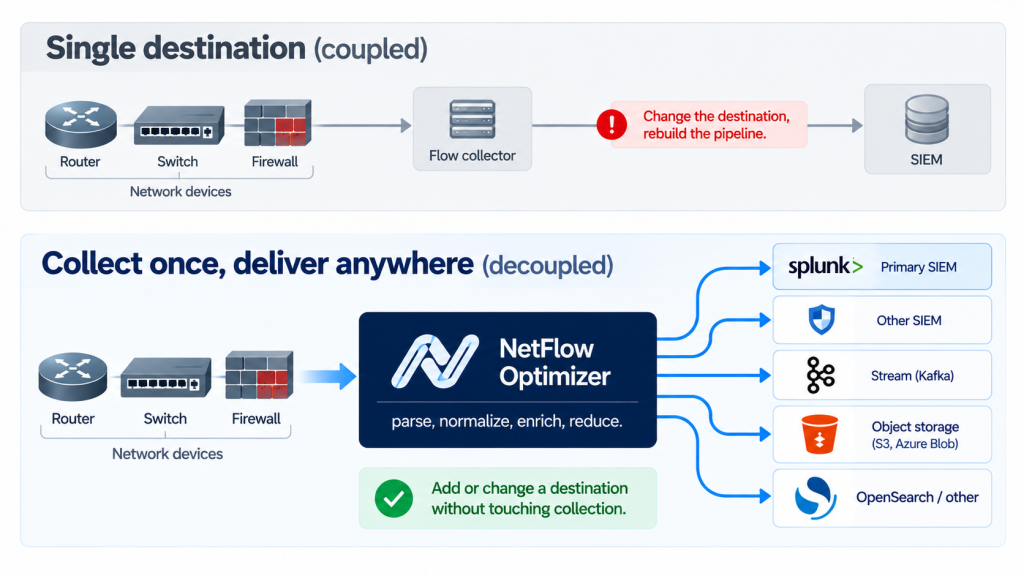
Most network telemetry pipelines are built the same way they were a decade ago: point the network devices at a collector wired to one destination, usually the SIEM, and leave it there. It works, right up until the destination changes. A SIEM migration, a new security data lake, a data-residency requirement, a team that wants the same flow data in a different tool: any of these turns a single-destination pipeline into a reconfiguration project.
The underlying issue is a coupling that does not need to exist. Collecting network telemetry and deciding where it goes are two separate jobs, but single-destination pipelines fuse them. The collection work (parsing binary flow, normalizing, enriching) has to be redone or re-pointed every time the downstream picture changes, even though the telemetry itself has not changed at all.
A better model separates the two: collect and process once, then deliver the finished telemetry to whatever destinations need it, in parallel, changeable without touching collection. That is how NetFlow Optimizer (NFO) is built.
The Cost of a Single-Destination Pipeline
When the pipeline is wired to one destination, several ordinary events become disruptive.
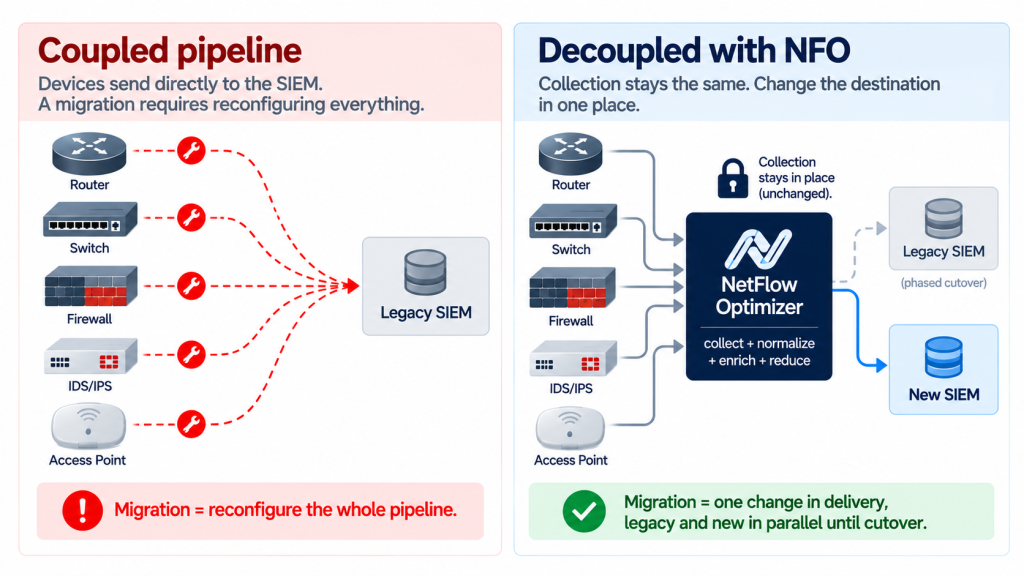
- A SIEM migration or consolidation. If the collector is tied to the legacy SIEM, moving to a new one means reworking the pipeline during the cutover, exactly when visibility matters most.
- Adding a second consumer. A data lake for long-term retention, a stream for real-time processing, an analytics tool for a different team: each becomes a new integration project rather than an added output.
- Data-residency or sovereignty rules. Needing some telemetry to land in a specific region, or to stay on-premises inside a controlled environment, forces changes a single-destination pipeline was never designed to make.
- Cost and tiering decisions. Sending enriched telemetry to hot, searchable storage and a copy to a lower-cost tier such as a Splunk Machine Data Lake or object storage is simple when delivery is decoupled, and painful when it is not.
In each case the telemetry is the same. Only the destination changed. A pipeline that fuses collection and delivery pays a reconfiguration tax every time that happens.
Collecting network telemetry and deciding where it goes are two separate jobs. Fuse them, and every change of destination becomes a pipeline project. Separate them, and a new destination is just another output.
Collect and Process Once
NFO does the hard, destination-independent work a single time. It ingests the binary NetFlow, IPFIX, sFlow, and J-Flow that routers, switches, and firewalls export, along with SNMP polling and Model-Driven Telemetry (MDT) for device health. It parses and normalizes all of it to a consistent schema, and enriches every record with user identity, application, threat intelligence, and geographic context. It also reduces volume by 80 to 90 percent, primarily through aggregation, before anything leaves the pipeline.
None of that work is tied to where the data is going. The parsing, normalization, enrichment, and reduction happen once, in the pipeline, producing finished telemetry that is ready for any consumer. The destination is a delivery decision made after the processing, not a constraint baked into it.
Deliver Anywhere, in Parallel
Once the telemetry is processed, NFO delivers it to the destinations that need it, more than one at a time if required. Splunk remains the primary SIEM for most deployments, receiving enriched, CIM-compliant telemetry ready for detection and hunting, with the NetFlow and SNMP Analytics for Splunk app on top. The same finished telemetry can go, simultaneously, to other consumers.
| Destination | Why send telemetry there |
| Splunk (primary SIEM) | Detection, correlation, and threat hunting on enriched, CIM-compliant network data |
| Microsoft Sentinel | A second SIEM for another business unit, or the new platform during a migration |
| Apache Kafka | Real-time streaming into other systems and data pipelines |
| Object storage (Amazon S3, Azure Blob) | Low-cost long-term retention |
| Exabeam, OpenSearch, and others | Team-specific analytics or an additional security platform |
Because delivery is decoupled from collection, adding or changing a destination is a configuration change in one place. The network devices keep exporting to NFO and never need to know what sits downstream. A SIEM migration becomes delivering to the legacy and new platforms in parallel until the cutover is validated, rather than a risky single switch. We walked through that scenario in detail in The Resilient NOC During a SIEM Migration. A new data lake becomes an added output, not a second pipeline.
Why This Matters Beyond Convenience
Decoupling collection from delivery is not only about avoiding reconfiguration work. It changes the organization’s relationship to its own telemetry. When the collection and enrichment layer is independent of any single destination, downstream platform decisions stop being constrained by the pipeline. You can adopt a new SIEM, add a security data lake, stream to a new system, or meet a new residency requirement as a delivery change, not a collection rebuild.
It also matters for AI. Splunk’s Machine Data Outlook research found that 53 percent of respondents frequently or always lack the machine data needed for AI or automated decision-making. Telemetry locked into one destination is one way that happens: the data exists, it just never reached the system that needed it.
That independence is worth the most at the moments that are hardest to plan for: the acquisition that doubles your tool set, the mandate that changes where data can live, the migration that cannot afford a visibility gap. A pipeline that collects once and delivers anywhere absorbs those changes. One that is wired to a single destination resists them.
As always, NFO’s role is collection, processing, and delivery. The detection, correlation, and visualization happen in the destinations, Splunk and the rest. NFO’s job is to get the same enriched, normalized telemetry to all of them, without the collection work being redone for each.
The Bottom Line
Network telemetry should be collected and enriched once, then delivered to whatever destinations need it. Fusing collection and delivery into a single-destination pipeline turns every migration, every new consumer, and every residency requirement into a reconfiguration project. NFO separates the two: it parses, normalizes, enriches, and reduces network telemetry a single time, then delivers that finished data to Splunk and, in parallel, to any other destination, changeable without touching collection.
Collect once. Deliver anywhere. Let the destination be a decision, not a constraint.
Want network telemetry that is not locked to one destination? Start a free 60-day trial of NetFlow Optimizer or schedule a technical demo with a NetFlow Logic engineer.
Start Free Trial | Schedule a Demo | Splunk Integration | NFO Documentation