
On November 13, 2026, the FBI released FLASH-20261113-001, Threat Overview of ARTEX Autonomous Penetration Testing Framework. ARTEX is an open-source framework built for authorized penetration testing: an operator states a goal in plain language, and a team of AI agents connected to large language models carries out the work. According to the FBI, a variety of malicious actors have used it since at least August 2026 to automate intrusions from reconnaissance through data exfiltration, against organizations in financial services, government, technology, defense, energy, healthcare, telecommunications, and other sectors.
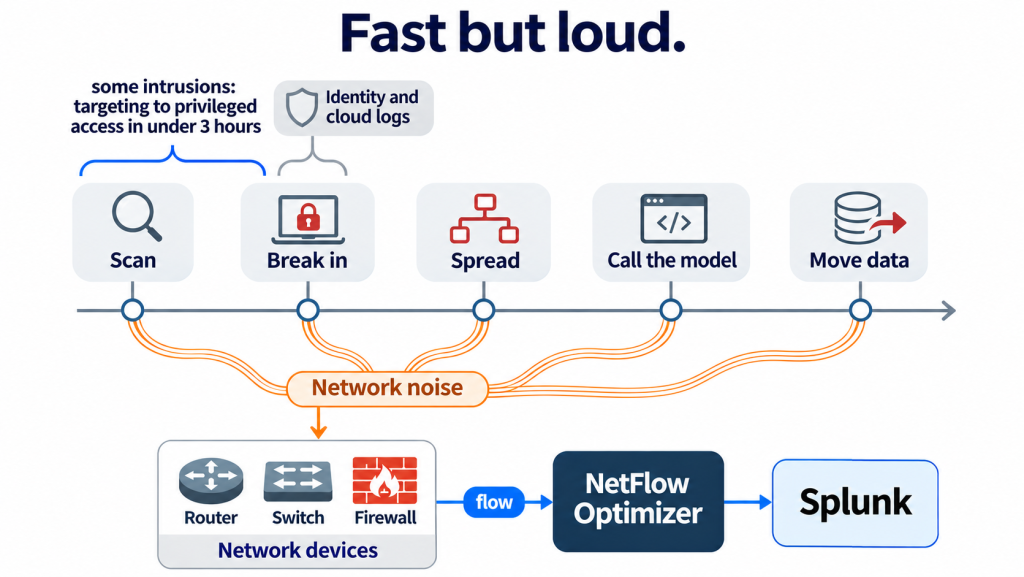
Two details from the advisory matter most for defenders. The first is speed: citing Microsoft, the FBI notes that some intrusions went from initial targeting to privileged access in under three hours. The second is noise. In the FBI’s words, ARTEX generates high volumes of forensically noisy traffic that may trigger alerts, even though the attack speed leaves limited time for a coordinated response.
Fast is a problem. Loud is an opportunity. An attacker who moves quickly but generates large volumes of traffic is leaving evidence on the network the whole way.
What the Agents Do
The techniques in the advisory are familiar ones. The FBI does not cite specific vulnerabilities by CVE. Its list of initial access methods is made up of common weaknesses: injection flaws, missing authentication on APIs, hardcoded and weak credentials, stolen VPN configurations, and abused trust relationships with third-party vendors. What changes is that an agent can chain those techniques in minutes and try many paths at once.
It is worth being clear about what network evidence will and will not see. Much of the activity in the advisory happens in identity and cloud control planes: abused service principals, OAuth applications, forged SAML tokens, and cloud permissions. Those leave their record in identity and cloud audit logs, and much of the FBI’s guidance rightly focuses there. Network flow will not show a forged token. It shows what the agent does with the network once it has one.
An agent can forge a token in milliseconds. It cannot scan, spread, call its model, or move data without crossing the network.
Where the Network Sees It
Many of the behaviors the FBI describes, and several of the indicators it asks organizations to report, are network activity. Each one crosses routers, switches, and firewalls that already export flow records.
| Activity described in the FBI advisory | What enriched network flow shows |
| Active scanning and web fuzzing against public-facing applications | Bursts of inbound connections from a single source to web servers, with GeoIP, ASN, and threat intelligence context on the source |
| Compressed bursts of activity and duplicate requests from sub-agents | Bursts of connections from the same source in short intervals, a pattern that stands out against normal user traffic |
| Unexpected outbound connections to LLM API endpoints | Servers connecting to AI providers’ networks, identified by destination ASN and correlated in the SIEM with DNS or proxy records |
| Command and control through residential proxies, Tor, SOCKS, and tunneling tools | Long-lived outbound sessions to proxy, anonymizer, or newly seen infrastructure, with threat intelligence matches where feeds list it |
| Lateral movement attempts against domain controllers (blocked by endpoint protection in the reported case) | Internal connections to domain controllers on remote management and authentication ports from hosts that do not normally make them |
| Exfiltration preparation, including command output sent to webhook services and outbound HTTPS transfers to unauthorized destinations | Outbound byte volumes to new or unusual destinations, by host, over time |
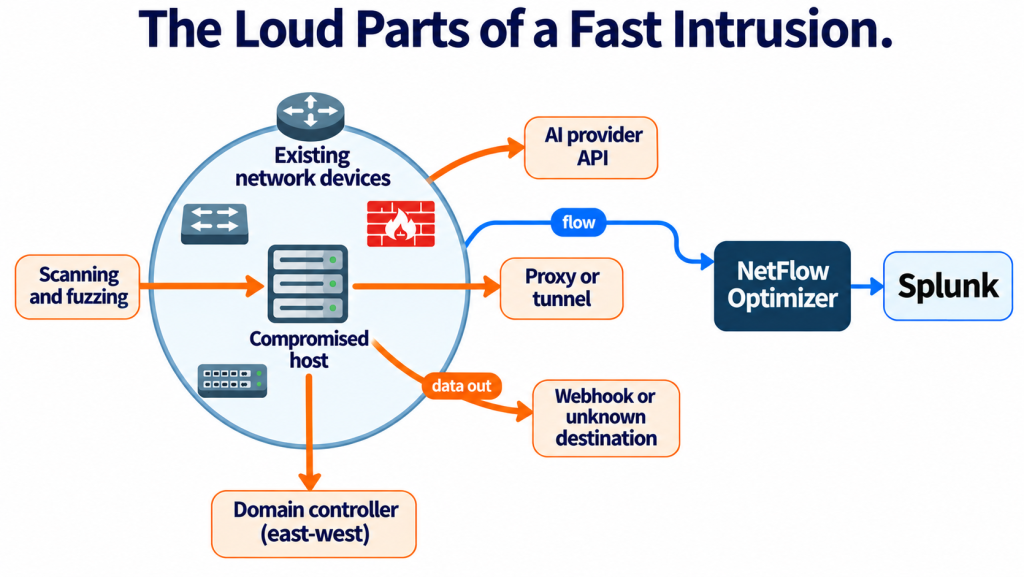
The outbound connection to an AI provider is worth singling out. The FBI lists unexpected outbound calls to LLM API endpoints as a behavioral indicator, and it asks organizations reporting incidents to include outbound connections to LLM APIs and related infrastructure. A server that has never talked to an AI provider and suddenly starts doing so is a question worth asking, especially as organizations adopt AI themselves and need a baseline that separates sanctioned use from everything else.
None of these signals proves compromise on its own. Together, they give hunters a short list of hosts, destinations, and time windows to examine alongside identity, endpoint, and cloud evidence.
Speed Makes Retained Evidence Matter
When an intrusion can reach privileged access in under three hours, the investigation that follows depends on evidence collected before anyone knew to look. Barracuda’s account of an ARTEX-linked intrusion shows the cost when that evidence is thin. As TechCrunch reported, Barracuda said its logs were not detailed enough to rule out access, so it chose to assume the worst and changed all of its customer credentials.
Scoping is a network question as much as an identity question: which hosts the attacker touched, which data stores it reached, what left the network, and when. The FBI’s own guidance asks organizations to preserve SIEM data and to report time to detection and containment. Answering those questions takes network history that is complete, enriched, and retained.
NetFlow Optimizer (NFO) provides that history. It collects flow from multi-vendor routers, switches, and firewalls, enriches each record with user identity where a mapping exists, application, threat intelligence, and GeoIP/ASN context, and reduces volume by 80 to 90 percent, primarily through aggregation. It delivers the result, CIM-compliant, to Splunk, where network evidence sits beside the identity and cloud logs the FBI highlights.
As always, NFO does not detect, alert, or decide what is malicious. It collects, enriches, reduces, and delivers. The detection, correlation, and response happen in Splunk.
The Bottom Line
The FBI’s ARTEX warning describes intrusions that move fast but leave a lot of noise behind them. Identity and cloud logs show how the attacker got in. Network evidence shows the scanning, the spread, the calls to AI models, the command and control, and the data leaving. NFO gives Splunk that evidence, enriched and retained, so teams can detect the noise while it is happening and scope the intrusion with facts instead of assumptions.
Fast attackers are still loud. Make sure someone is listening.
Want enriched network evidence in Splunk before the next fast intrusion? Start a free 60-day trial of NetFlow Optimizer or schedule a technical demo with a NetFlow Logic engineer.
Start Free Trial | Schedule a Demo | Splunk Integration | NFO Documentation